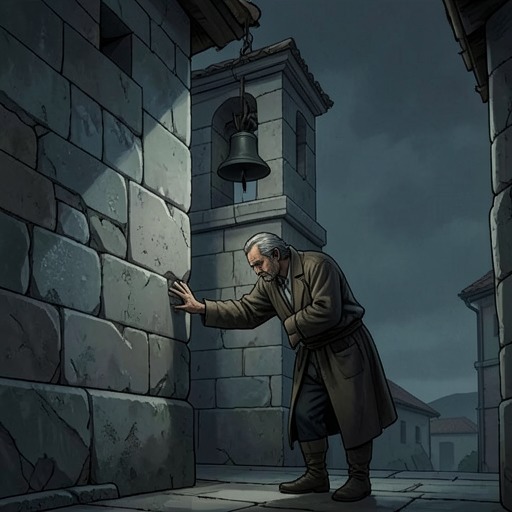
Claude Frollo and Quasimodo
The Hunchback of Notre DameClaude Frollo and Quasimodo are bound as archdeacon and bellringer, but their relationship is more than a formal tie of service: it is a starkly unequal attachment enacted through signs, submission, and protection. When Claude appears in public and strips Quasimodo of the insignia of his mock papacy, the powerful bellringer does not retaliate. He falls to his knees, follows Claude’s command, and later places his strength between the priest and the crowd. Their encounter shows a bond in which Claude directs and Quasimodo serves, even though the physical power between them runs in the opposite direction.
Identity and the Bond of Service
Quasimodo’s connection to Claude is first made explicit when Jehan recognizes him as his brother’s bellringer. Claude is the archdeacon, and Quasimodo’s work ringing the bells is also the stated cause of his deafness. An old woman clarifies that he can speak when he chooses and is not mute. The distinction matters to the relationship: Quasimodo’s deafness does not prevent communication between the two men, but their decisive exchange takes place without speech.
The public has already reduced Quasimodo to a catalogue of bodily differences: he is described as hunchbacked, bandy-legged, one-eyed, and deaf. The relationship with Claude is not explained through a history of how it began in this scene; instead, it appears in the practical and visible forms of service, recognition, and command. Claude is identified by his ecclesiastical office, while Quasimodo is identified through his labor as the bellringer. That contrast frames their bond in terms of institutional standing and personal dependence without making the bellringer’s physical strength any less evident.
The Public Reversal at the House of Pillars
The relationship becomes dramatically visible as Quasimodo passes the House of Pillars in the triumph of his election as Pope of the Fools. He carries a gilded wooden crosier, the emblem of his mock office, and the crowd’s response gives the moment a celebratory, almost royal shape. Claude suddenly emerges and tears the crosier from his hands. The gesture is an abrupt public reversal: the man being acclaimed as a pope is stripped of his emblem by the archdeacon who claims authority over him.
The crowd expects violence. Quasimodo has already been made frightening by his size and appearance, and when he leaps from the litter people turn away, imagining that he will tear Claude apart. Instead, he bounds to the priest, looks at him, and drops to his knees. Claude removes Quasimodo’s tiara, breaks the crosier, and rends the tinsel cope. Quasimodo remains bowed, his hands clasped. The contrast between the threatened violence and this immediate submission defines the scene: Claude acts upon Quasimodo’s public status, while Quasimodo’s answer is not resistance but supplication.
Command, Communication, and Protection
Neither man speaks during their exchange. The narration describes a dialogue made of signs and gestures: Claude stands upright, angry, threatening, and imperious; Quasimodo is prostrate, humble, and suppliant. This is not simply an absence of conversation. It is the means by which their relationship operates in the scene. Quasimodo is deaf, Claude’s authority is expressed through visible gestures, and a rough shake of Quasimodo’s powerful shoulder accompanies the sign ordering him to rise and follow. Quasimodo rises and obeys.
That obedience does not mean Quasimodo is physically powerless. The narration stresses that he could crush Claude with his thumb. The gap between what he could do and what he does is central to the encounter: Claude possesses command over him despite their immense difference in bodily strength. The scene shows Quasimodo responding to Claude’s direction, but it does not explain his private thoughts or give a spoken account of why he submits. The evidence is in his posture and actions—kneeling, clasping his hands, rising at the sign, and going with the priest.
When the Brotherhood of Fools and others gather around Claude, howling in defense of their dethroned pope, Quasimodo reverses his position without changing his allegiance. He steps in front of Claude and sets his powerful fists in motion, glaring at the assailants like an angry tiger. The crowd that had feared he would attack the priest now faces him as the priest’s defender. Claude resumes his sombre gravity, signals to Quasimodo, and withdraws in silence; Quasimodo walks in front of him, scattering the crowd.
The Shape and Significance of Their Relationship
The pair’s exit makes their different functions especially clear. Once they have crossed the populace and the Place, Quasimodo becomes the rearguard, walking backward behind Claude as the curious crowd considers following. His looks and gestures, accompanied by a growl, keep the onlookers at a distance. The two men are then able to enter a dark, narrow street that no one dares follow them into. Quasimodo’s strength, first imagined as a danger to Claude, has become the force that secures the priest’s retreat.
The encounter thus gives the relationship a compact but revealing pattern: Claude removes Quasimodo’s insignia, commands him through signs, and leads him away; Quasimodo submits, then guards him against others. The exchange is not balanced in authority, though the physical danger is reciprocal in possibility. Claude can direct the man who might crush him, while Quasimodo uses that formidable capacity in Claude’s defense. Their bond is conveyed less by explanation than by the sequence of gestures—seizure, kneeling, command, obedience, interposition, and escort—making the bellringer’s dependence and protective service legible without a spoken word.